German Pronouns: Complete Guide
German pronouns change based on case - just like articles. Mastering pronoun declension is essential for fluent German.
If you’re not confident with cases yet, start here: German cases.
Why pronouns are worth learning early
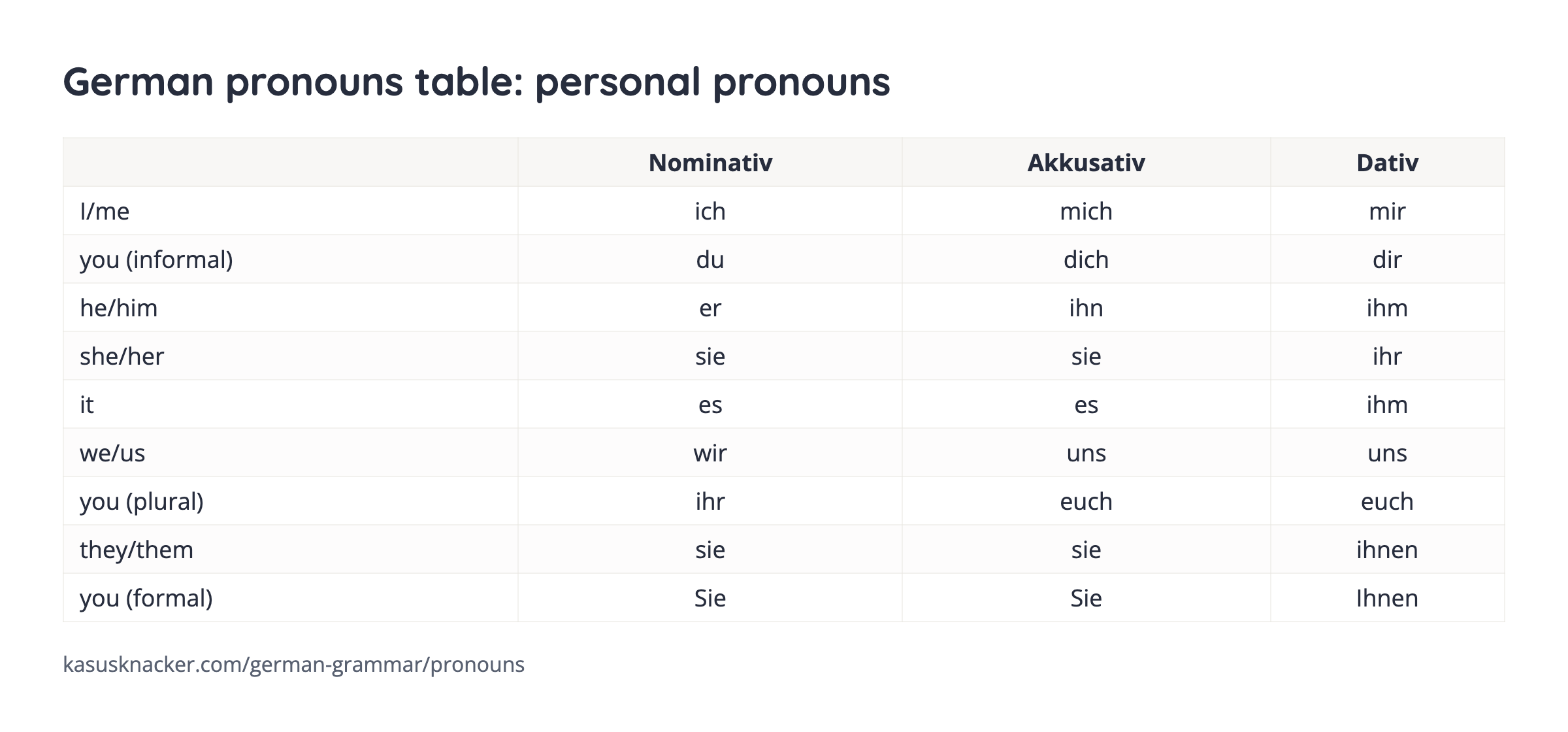
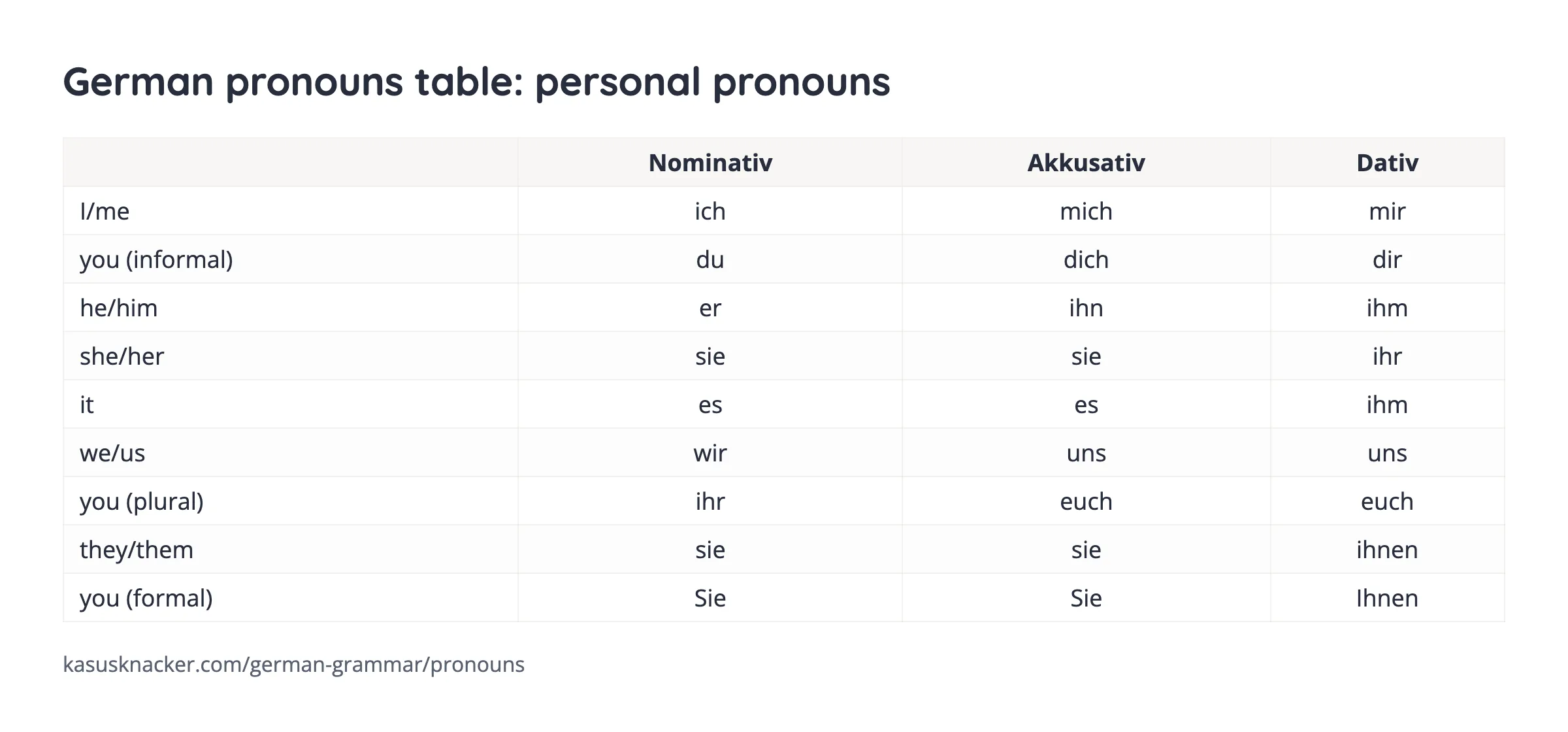
German pronouns table: personal pronouns
Use this table to see how personal pronouns like ich, du and er change when they move into the accusative or dative case.
| Nominativ | Akkusativ | Dativ | |
|---|---|---|---|
| I/me | ich | mich | mir |
| you (informal) | du | dich | dir |
| he/him | er | ihn | ihm |
| she/her | sie | sie | ihr |
| it | es | es | ihm |
| we/us | wir | uns | uns |
| you (plural) | ihr | euch | euch |
| they/them | sie | sie | ihnen |
| you (formal) | Sie | Sie | Ihnen |
The Most Common Confusion: sie vs Sie
German uses the same word for several different pronouns:
| Form | Meaning | How to recognize it | Example |
|---|---|---|---|
| sie | she | 3rd person singular feminine | Sie kommt heute. |
| sie | they | 3rd person plural | Sie kommen heute. |
| Sie | you (formal) | capital S + formal context | Kommen Sie heute? |
Hack
Nominative Pronouns (Subject)
Nominative pronouns are the subject of the sentence - who does the action.
Ich lerne Deutsch.
I am learning German.
Er arbeitet in Berlin.
He works in Berlin.
Accusative Pronouns (Direct Object)
Accusative pronouns are the direct object - what receives the action directly.
| Nominativ | Akkusativ | Example |
|---|---|---|
| ich | mich | Er sieht mich. |
| du | dich | Ich kenne dich. |
| er | ihn | Sie liebt ihn. |
| sie | sie | Er trifft sie. |
| es | es | Ich nehme es. |
| wir | uns | Er besucht uns. |
| ihr | euch | Ich sehe euch. |
| sie/Sie | sie/Sie | Wir kennen Sie. |
Kannst du mich hören?
Can you hear me?
Ich liebe dich.
I love you.
Pattern
Quick pair to remember: ihn vs ihm
Ich sehe ihn.
I see him. (direct object → accusative)
Ich helfe ihm.
I help him. (helfen takes dative)
Dative Pronouns (Indirect Object)
Dative pronouns are the indirect object - who benefits from or receives something.
| Nominativ | Dativ | Example |
|---|---|---|
| ich | mir | Er gibt mir das Buch. |
| du | dir | Ich sage dir die Wahrheit. |
| er | ihm | Sie schreibt ihm einen Brief. |
| sie | ihr | Er schenkt ihr Blumen. |
| es | ihm | Ich gebe ihm Wasser. |
| wir | uns | Er erzählt uns eine Geschichte. |
| ihr | euch | Ich zeige euch das Haus. |
| sie/Sie | ihnen/Ihnen | Wir danken Ihnen. |
Kannst du mir helfen?
Can you help me?
Ich gebe dir mein Buch.
I give you my book.
Important
Accusative vs. Dative: When to Use Which?
| Use Akkusativ | Use Dativ |
|---|---|
| Direct objects | Indirect objects (to/for whom) |
| After akkusativ prepositions | After dativ prepositions |
| Most transitive verbs | Verbs like helfen, danken, gefallen |
Sie gibt ihm (Dat) das Buch (Akk).
She gives him the book.
es vs das (Another Classic Trap)
Both can mean “it”, but they are used differently:
| Use | Pronoun | Example | Meaning |
|---|---|---|---|
| Neutral “it” for a noun | es | Ich nehme es. | I take it. |
| Refers to an idea/clause ("that") | das | Das ist gut. | That’s good. |
| Weather/time/general statements | es | Es regnet. | It’s raining. |
Simple rule
Reflexive Pronouns
Reflexive pronouns refer back to the subject. They can be accusative or dative:
| Subject | Reflexiv Akk | Reflexiv Dat |
|---|---|---|
| ich | mich | mir |
| du | dich | dir |
| er/sie/es | sich | sich |
| wir | uns | uns |
| ihr | euch | euch |
| sie/Sie | sich | sich |
Ich wasche mich.
I wash myself.
Ich wasche mir die Hände.
I wash my hands. (lit: I wash to-me the hands)
Common Reflexive Verbs
| Verb | Meaning | Example |
|---|---|---|
| sich freuen | to be happy | Ich freue mich. |
| sich erinnern | to remember | Erinnerst du dich? |
| sich setzen | to sit down | Er setzt sich. |
| sich fühlen | to feel | Wie fühlst du dich? |
| sich vorstellen | to introduce oneself | Ich stelle mich vor. |
Relative Pronouns (der/die/das)
Relative pronouns introduce relative clauses (“who/that/which”). In German, they look like the definite articles (der/die/das) and change by case.
Das ist der Mann, der hier wohnt.
That is the man who lives here.
Das ist der Mann, den ich kenne.
That is the man (whom) I know.
How to pick the form
Word Order with Pronouns
When you have multiple pronouns, follow this order:
Rule: Accusative before Dative (for pronouns)
Ich gebe es ihm.
I give it to him.
But with a noun + pronoun, dative pronoun comes first:
Ich gebe ihm das Buch.
I give him the book.
Memory Rule
Also common (noun objects): dative often comes before accusative:
Sie gibt dem Mann das Buch.
She gives the man the book.
Quick Reference Card
| Pronoun | Nom | Akk | Dat |
|---|---|---|---|
| 1st sing. | ich | mich | mir |
| 2nd sing. | du | dich | dir |
| 3rd masc. | er | ihn | ihm |
| 3rd fem. | sie | sie | ihr |
| 3rd neut. | es | es | ihm |
| 1st plur. | wir | uns | uns |
| 2nd plur. | ihr | euch | euch |
| 3rd plur. | sie | sie | ihnen |
| formal | Sie | Sie | Ihnen |
Common Mistakes (and Fixes)
Mistake 1: Treating Sie (formal) like sie (they)
Mistake 2: Mixing up ihr (to her) and ihr (you plural)
Mistake 3: Forgetting that some verbs demand dative
FAQ
Do German pronouns change with cases?
Yes. Personal pronouns change by case (ich/mich/mir, du/dich/dir, etc.). This is one of the most important shortcuts for case accuracy.
What is the difference between sie and Sie?
sie is “she” or “they” depending on context, while Sie (capital S) is formal “you”.
When do I use reflexive pronouns?
Use reflexive pronouns with reflexive verbs (sich erinnern, sich freuen) and when the subject and object are the same person.
How do I practice pronouns effectively?
Drill them in short sentences and substitute nouns with pronouns (der Mann -> er/ihn/ihm). This reinforces both pronouns and cases.
Last updated:
Preparing for a German exam? See the core exam grammar checklist for A1–C1 →
Wrote a sentence with this rule? Check it with Schreibcheck →
Start cracking German grammar today.
Join thousands of learners mastering the German language with KasusKnacker.