German Possessive Articles: Complete Guide
Possessive articles (my, your, his, her, etc.) in German change based on the gender, case, and number of the noun they modify. They follow the same pattern as "ein/eine/ein".
If you’re still shaky on cases or adjective endings, these help a lot:
The big idea
- You pick mein/dein/sein/ihr/unser/euer/Ihr based on the owner.
- You pick the ending based on the thing owned (gender/number + case).
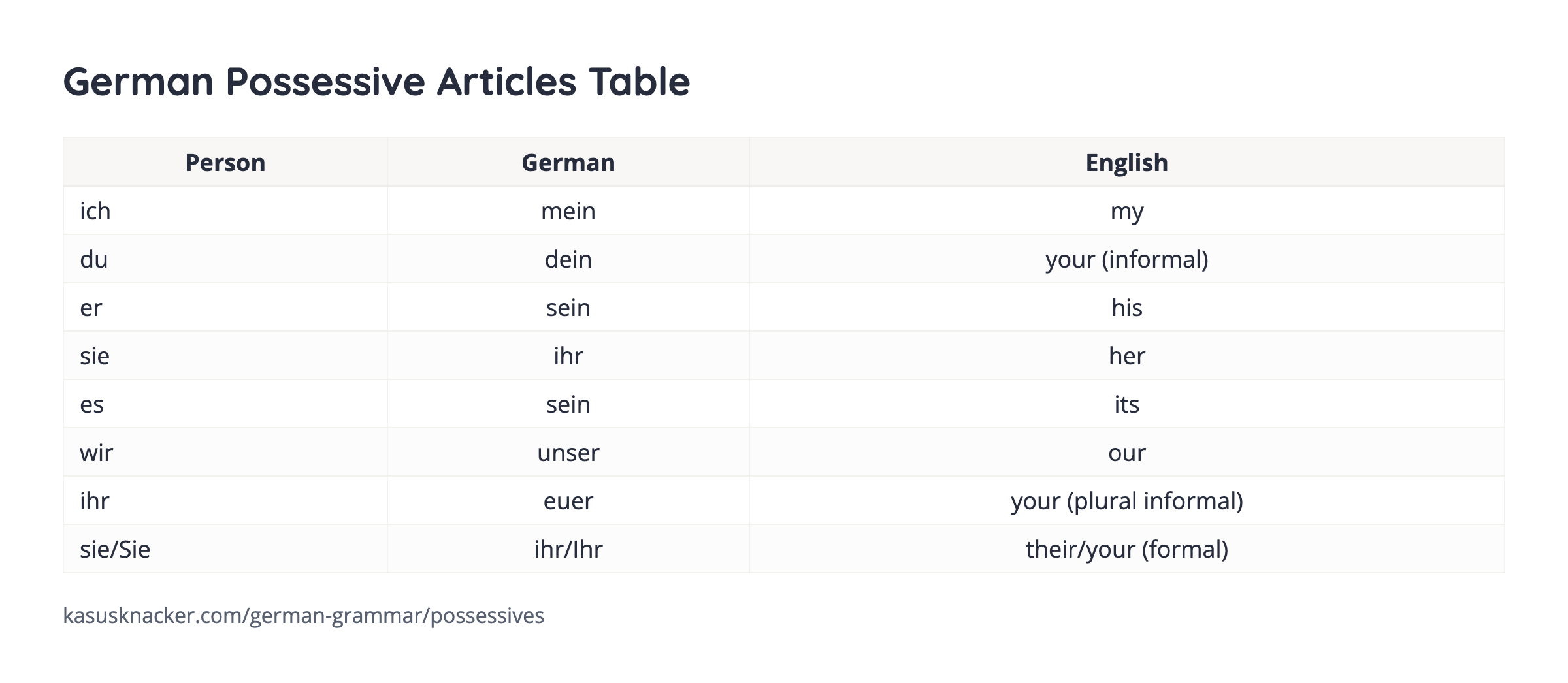
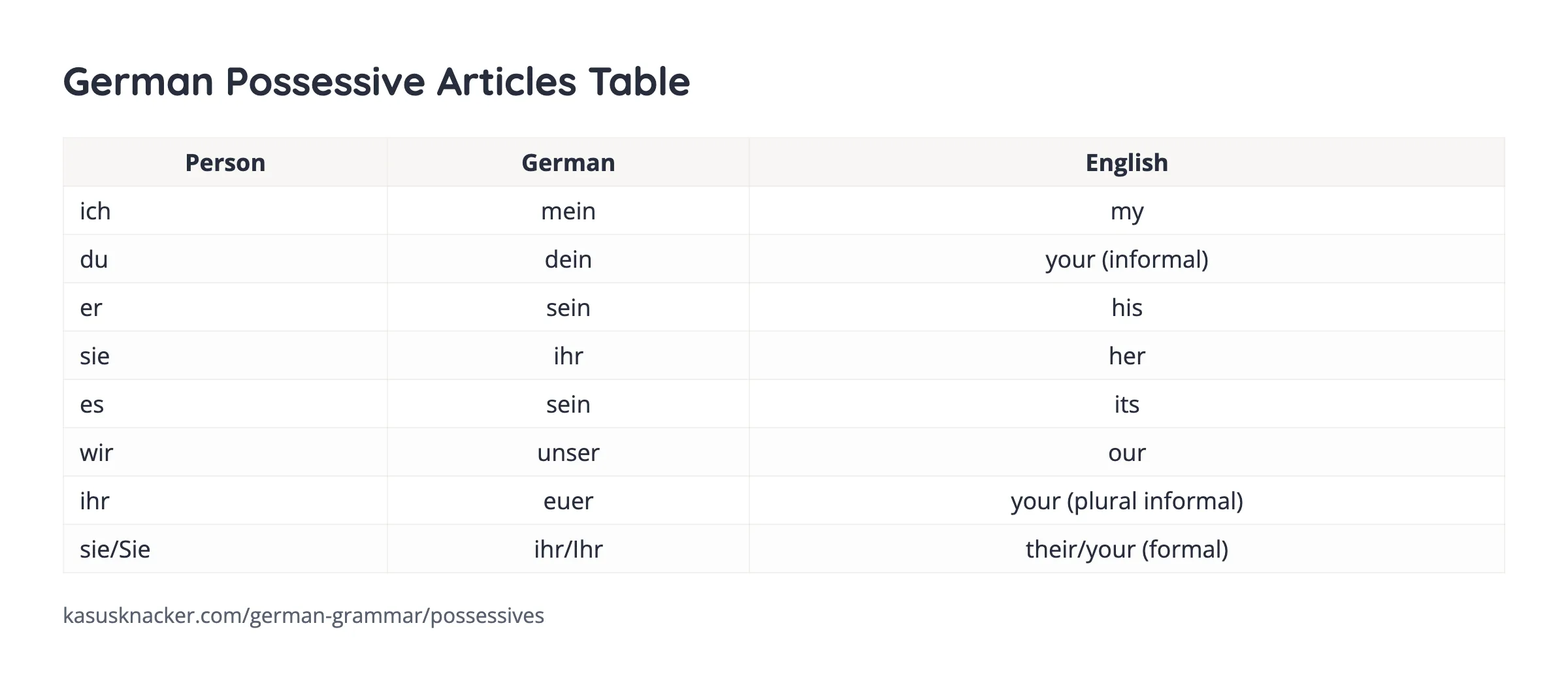
German Possessive Articles Table
| Person | German | English |
|---|---|---|
| ich | mein | my |
| du | dein | your (informal) |
| er | sein | his |
| sie | ihr | her |
| es | sein | its |
| wir | unser | our |
| ihr | euer | your (plural informal) |
| sie/Sie | ihr/Ihr | their/your (formal) |
Possessive Declension Table: All Four Cases
Here's the full declension table for "mein" - every other German possessive article (dein, sein, ihr, unser, euer, Ihr) takes exactly the same endings:
| Case | Masculine | Feminine | Neuter | Plural |
|---|---|---|---|---|
| Nominativ | mein | meine | mein | meine |
| Akkusativ | meinen | meine | mein | meine |
| Dativ | meinem | meiner | meinem | meinen |
| Genitiv | meines | meiner | meines | meiner |
ihr vs Ihr vs ihr (Three Different Things)
This is one of the most common points of confusion because the spelling overlaps:
| Form | Type | Meaning | Example |
|---|---|---|---|
| ihr | possessive | her | Sie liest ihr Buch. |
| ihr | possessive | their | Sie lesen ihr Buch. |
| Ihr | possessive | your (formal) | Lesen Sie Ihr Buch? |
| ihr | pronoun | you (plural informal) | Ihr seid heute hier. |
Hack
Possessives in Nominativ
When the possessive article is in the nominative case (as a subject):
| Masculine | Feminine | Neuter | Plural | |
|---|---|---|---|---|
| mein | mein Vater | meine Mutter | mein Kind | meine Kinder |
| dein | dein Vater | deine Mutter | dein Kind | deine Kinder |
| sein | sein Vater | seine Mutter | sein Kind | seine Kinder |
Mein Bruder ist Arzt.
My brother is a doctor.
Possessives in Akkusativ
When the possessive article is in the accusative case (as a direct object):
| Masculine | Feminine | Neuter | Plural | |
|---|---|---|---|---|
| mein | meinen Vater | meine Mutter | mein Kind | meine Kinder |
| dein | deinen Vater | deine Mutter | dein Kind | deine Kinder |
| sein | seinen Vater | seine Mutter | sein Kind | seine Kinder |
Ich besuche meinen Onkel.
I'm visiting my uncle.
Possessives in Dativ
When the possessive article is in the dative case (as an indirect object):
| Masculine | Feminine | Neuter | Plural | |
|---|---|---|---|---|
| mein | meinem Vater | meiner Mutter | meinem Kind | meinen Kindern |
| dein | deinem Vater | deiner Mutter | deinem Kind | deinen Kindern |
| sein | seinem Vater | seiner Mutter | seinem Kind | seinen Kindern |
Ich gebe meiner Schwester ein Geschenk.
I give my sister a gift.
Er hilft seinem Freund.
He helps his friend.
Two changes in dative plural
- possessive ending -en: meinen
- noun ending -n (if possible): Kindern, Freunden
Possessives in Genitiv
When showing possession of possession (rarely used in spoken German):
| Masculine | Feminine | Neuter | Plural | |
|---|---|---|---|---|
| mein | meines Vaters | meiner Mutter | meines Kindes | meiner Kinder |
| dein | deines Vaters | deiner Mutter | deines Kindes | deiner Kinder |
| sein | seines Vaters | seiner Mutter | seines Kindes | seiner Kinder |
Das Auto meines Vaters ist rot.
My father's car is red.
His vs. Her (sein vs. ihr)
A common source of confusion: German possessives match the owner's gender, not the object's gender:
Er liebt seine Mutter.
He loves his mother.
Sie liebt ihre Mutter.
She loves her mother.
Common Mistake
Worked Examples (Two-Step Process in Action)
Same object, different owners
Object: die Mutter (feminine). The ending is therefore often -e in nominative/accusative.
Er besucht seine Mutter.
He visits his mother.
Sie besucht ihre Mutter.
She visits her mother.
Same owner, different cases
Owner: ich → base word mein. Now the ending changes by case:
Mein Hund ist klein.
My dog is small.
Ich sehe meinen Hund.
I see my dog.
Ich spiele mit meinem Hund.
I play with my dog.
Possessive Articles vs Possessive Pronouns (Mine/Yours)
These pages focus on possessive articles (my book = mein Buch). In English you also say “mine” without a noun.
German does this too, but it’s a different form:
| English | German example | Meaning |
|---|---|---|
| my book | Das ist mein Buch. | possessive article + noun |
| mine | Das ist meins. | possessive pronoun (stands alone) |
Tips for Possessives
Two-Step Process
Same as "ein"
Common Mistakes (and Fixes)
Mistake 1: Choosing the possessive by the object
Mistake 2: Forgetting euer loses -e-
Mistake 3: Not practicing full phrases
FAQ
What are German possessive articles?
Words like mein, dein, sein, ihr, unser, euer. They behave like ein- words, so their endings and the adjective endings that follow are part of the same pattern.
Is ihr “her” or “their”?
Both. ihr can mean “her” or “their” depending on context. The endings also change by case and gender.
Do possessives change with case?
Yes. For example: mein Hund (nominative), meinen Hund (accusative), meinem Hund (dative).
How do I avoid mistakes with possessives?
Practice the ein-word chart and always practice in full noun phrases (e.g., mit meinem Bruder, ich sehe meinen Bruder).
Last updated:
Preparing for a German exam? See the core exam grammar checklist for A1–C1 →
Wrote a sentence with this rule? Check it with Schreibcheck →
Start cracking German grammar today.
Join thousands of learners mastering the German language with KasusKnacker.