German Cases: The Complete Guide
German has four grammatical cases that change how articles, adjectives, and pronouns are declined. Understanding cases is essential for speaking German correctly.
Cases feel hard when you try to memorize tables first. They get much easier when you learn what each case does in a sentence, and you follow a simple decision process.
Fastest shortcut
How Many Cases Does German Have?
German has four cases: Nominativ (nominative), Akkusativ (accusative), Dativ (dative) and Genitiv (genitive). Every noun phrase in a German sentence sits in exactly one of them, and the case decides which article and adjective ending you use.
That is fewer than Russian (six) or Finnish (fifteen), and only one more than English pronouns already have — English still says I / me / my, which is nominative, accusative and genitive in disguise.
The German Case System: Nominative, Accusative, Dative, Genitive
Each case answers a specific question. Ask the question about your sentence and the case falls out:
| Case | Role in the sentence | Question word | Example |
|---|---|---|---|
| Nominativ | Subject — who or what is doing it | wer? / was? | Der Mann liest. |
| Akkusativ | Direct object — what is acted on | wen? / was? | Ich sehe den Mann. |
| Dativ | Indirect object — to or for whom | wem? | Ich gebe dem Mann das Buch. |
| Genitiv | Possession — whose | wessen? | Das Auto des Mannes. |
The four question words are the fastest test
A Practical Checklist (How to Pick the Case)
Use this in real sentences. It’s the same thought process German speakers learn in school:
- Is there a preposition? Learn the preposition with its case (mit + dative, fuer + accusative, wegen + genitive, etc.). (See also: German prepositions.)
- Is it a two-way preposition (in/an/auf/unter/ueber/vor/hinter/neben/zwischen)?
- Motion/destination (wohin?) → usually accusative
- Location/state (wo?) → usually dative
- What is the subject (who/what does the action)? That noun phrase is nominative.
- What is the direct object (what gets acted on)? That noun phrase is usually accusative.
- Is there an indirect recipient (to/for whom)? That noun phrase is usually dative.
- Is it possession (“of”, “whose”)? That noun phrase can be genitive (especially in writing) or replaced with a dative/von construction in speech.
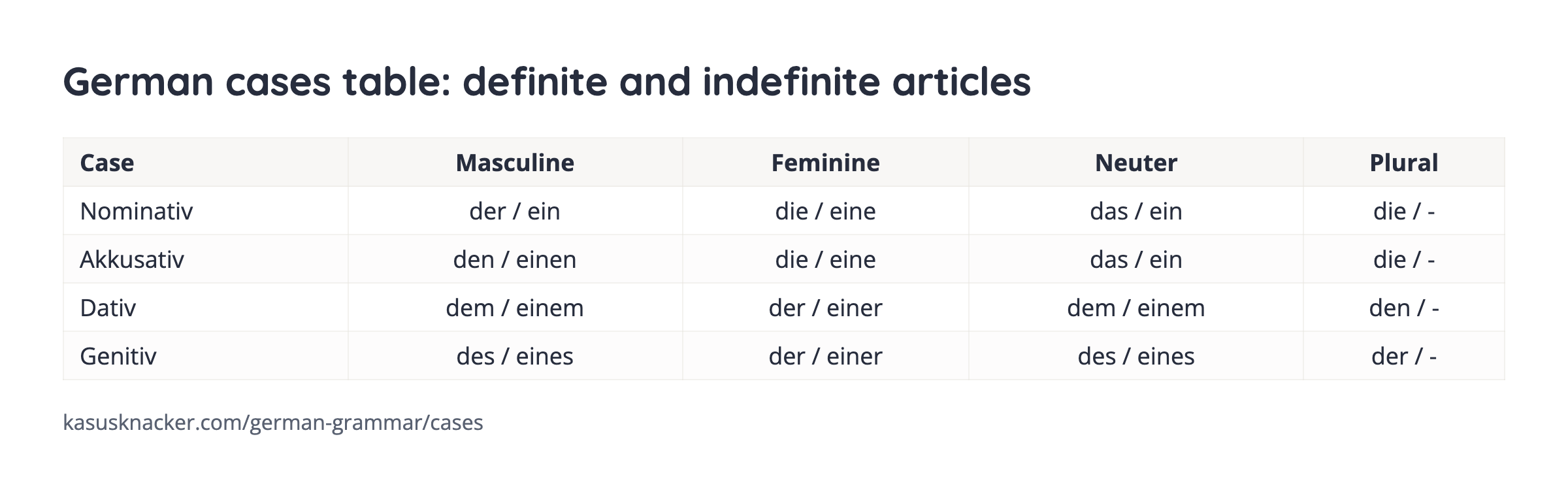
German cases table: definite and indefinite articles
This table shows the definite and indefinite articles across all four cases, so you can easily spot the changing endings.
| Case | Masculine | Feminine | Neuter | Plural |
|---|---|---|---|---|
| Nominativ | der / ein | die / eine | das / ein | die / - |
| Akkusativ | den / einen | die / eine | das / ein | die / - |
| Dativ | dem / einem | der / einer | dem / einem | den / - |
| Genitiv | des / eines | der / einer | des / eines | der / - |
Nominativ (Nominative Case)
The nominative case marks the subject of a sentence - the person or thing performing the action.
Der Mann liest ein Buch.
The man reads a book.
When to Use Nominativ
- Subject of any sentence: Who or what is doing the action
- After "sein" (to be), "werden" (to become), and "bleiben" (to stay/remain) (these don’t take a direct object)
Das ist ein guter Freund.
That is a good friend.
Er bleibt ein Student.
He remains a student.
Remember
Akkusativ (Accusative Case)
The accusative marks the direct object - what is directly affected by the action.
Ich sehe den Mann.
I see the man.
When to Use Akkusativ
- Direct objects: What receives the action directly
- After accusative prepositions: durch, für, gegen, ohne, um, bis, entlang
- With two-way prepositions indicating motion toward a destination
Sie geht durch den Park.
She walks through the park.
Useful Extra: Time & Distance (Often Akkusativ)
German often uses the accusative for “how long / how far”:
Ich lerne jeden Tag Deutsch.
I study German every day.
Wir warten eine Stunde.
We wait for an hour.
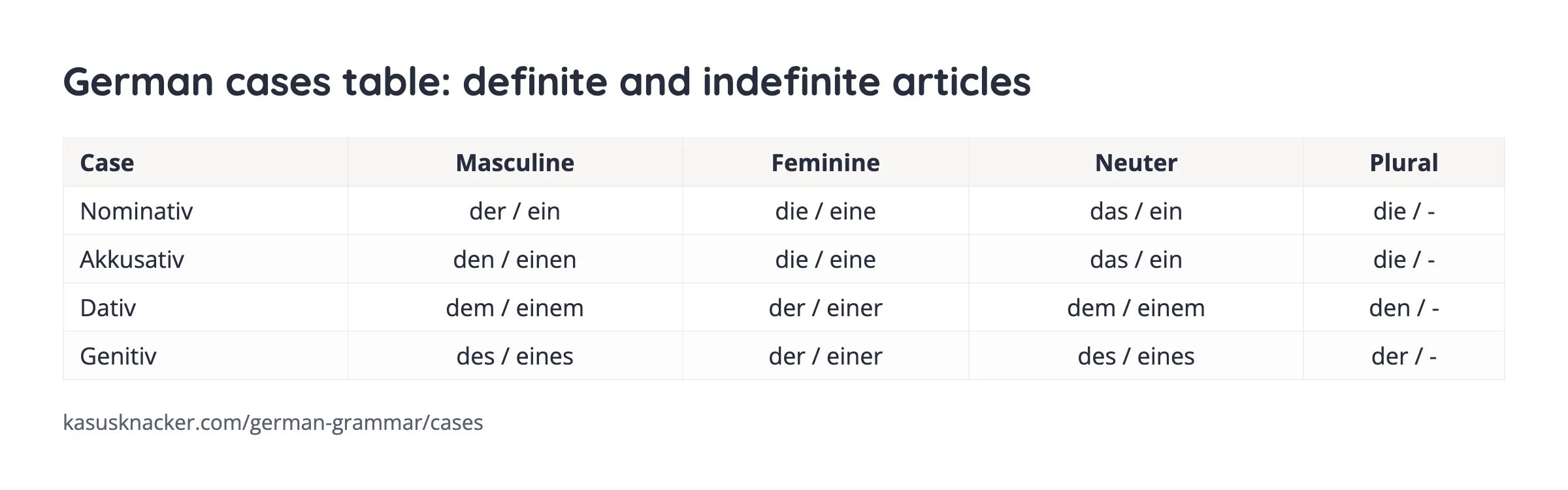
Akkusativ Article Changes
| Case | Masculine | Feminine | Neuter | Plural |
|---|---|---|---|---|
| Nominativ | der / ein | die / eine | das / ein | die / - |
| Akkusativ | den / einen | die / eine | das / ein | die / - |
| Dativ | dem / einem | der / einer | dem / einem | den / - |
| Genitiv | des / eines | der / einer | des / eines | der / - |
Dativ (Dative Case)
The dative marks the indirect object - who receives the direct object or benefits from the action.
Ich gebe dem Mann das Buch.
I give the book to the man.
When to Use Dativ
- Indirect objects: To whom something is given/said/shown
- After dative prepositions: aus, außer, bei, gegenüber, mit, nach, seit, von, zu
- After certain verbs: helfen, danken, gefallen, gehören, folgen, antworten
- With two-way prepositions indicating location (no motion)
Das Buch gehört meiner Schwester.
The book belongs to my sister.
Most common dative patterns
- mit + dative: mit dem Freund, mit der Frau, mit den Kindern
- verbs like helfen and gefallen: Das hilft mir. Das gefaellt mir.
Dativ Article Changes
| Masculine | Feminine | Neuter | Plural | |
|---|---|---|---|---|
| Definite | dem | der | dem | den (+n) |
| Indefinite | einem | einer | einem | — |
Don't Forget!
Verbs That Force a Case
Some verbs simply demand a case, no matter what the sentence means. These are worth learning as vocabulary — with the case attached, the way you learn nouns with their article.
| Always dative | Meaning | Always accusative | Meaning |
|---|---|---|---|
| helfen | to help | sehen | to see |
| danken | to thank | haben | to have |
| gefallen | to please / to like | brauchen | to need |
| gehören | to belong to | kennen | to know (a person) |
| folgen | to follow | fragen | to ask |
| antworten | to answer | besuchen | to visit |
| passen | to fit / to suit | lieben | to love |
| schmecken | to taste good to | verstehen | to understand |
Why the dative column feels wrong
Der Film gefällt meinem Bruder.
My brother likes the film. (literally: the film pleases my brother)
Two-Way Prepositions (Accusative vs Dative)
Two-way prepositions (Wechselpraepositionen) can be accusative or dative depending on meaning:
- wohin? (to where / destination / change of position) → usually accusative
- wo? (where / location / no movement) → usually dative
Common two-way prepositions: in, an, auf, unter, ueber, vor, hinter, neben, zwischen
Ich gehe in die Schule.
I’m going to school. (destination)
Ich bin in der Schule.
I’m at school. (location)
Ich haenge das Bild an die Wand.
I hang the picture onto the wall. (movement)
Das Bild haengt an der Wand.
The picture is hanging on the wall. (location)
Quick test
Genitiv (Genitive Case)
The genitive shows possession - whose something is.
Das ist das Auto des Mannes.
That is the man's car.
When to Use Genitiv
- Possession: Whose something belongs to
- After genitive prepositions: wegen, trotz, während, statt, innerhalb, außerhalb
Trotz des Regens gehen wir spazieren.
Despite the rain, we go for a walk.
Genitiv Article Changes
| Masculine | Feminine | Neuter | Plural | |
|---|---|---|---|---|
| Definite | des (+s/es) | der | des (+s/es) | der |
| Indefinite | eines (+s/es) | einer | eines (+s/es) | — |
Real-life note
Worked Examples: One Noun Through All Four Cases
The clearest way to feel the system is to watch a single noun move through every case. Here is der Mann doing all four jobs:
Der Mann kauft ein Auto.
The man buys a car.
Ich sehe den Mann.
I see the man.
Ich gebe dem Mann einen Schlüssel.
I give the man a key.
Das ist das Auto des Mannes.
That is the man's car.
Same man, same word, four different forms: der → den → dem → des (+ -es on the noun). Nothing about the man changed; only his job in the sentence did.
Two Objects in One Sentence
Most real sentences combine cases. Verbs of giving and telling take a dative person and an accusative thing:
Die Lehrerin erklärt den Schülern die Regel.
The teacher explains the rule to the students.
Ask the questions: wer explains? Die Lehrerin (nominative). Was does she explain? Die Regel (accusative). Wem does she explain it? Den Schülern (dative — plural, so the noun takes -n too).
Complete Article Declension
| Case | Masculine | Feminine | Neuter | Plural |
|---|---|---|---|---|
| Nominativ | der / ein | die / eine | das / ein | die / - |
| Akkusativ | den / einen | die / eine | das / ein | die / - |
| Dativ | dem / einem | der / einer | dem / einem | den / - |
| Genitiv | des / eines | der / einer | des / eines | der / - |
Possessive articles (mein, dein, sein…) decline exactly like ein/kein — see the German possessive articles table for the full pattern.
Quick Tips for Remembering Cases
The Accusative Rule
The Dative Rule
The Genitive Rule
Common Case Mistakes (and How to Fix Them)
Mistake 1: Using nominative after a preposition
Mistake 2: Forgetting the dative plural
Mistake 3: Two-way prepositions without thinking motion vs location
Which Case Is the Hardest?
For most learners it is the dative, and for two specific reasons rather than any general difficulty.
The first is the verb list above: helfen, danken, gefallen, gehören take a dative object where English uses a direct one, so intuition actively works against you. The second is the plural -n on the noun itself — mit den Kindern, not "mit den Kinder" — which is invisible in the article table and therefore easy to skip.
The genitive looks intimidating but is actually the easiest to postpone: spoken German routinely replaces it with von + dative (das Auto von meinem Bruder). You need to recognize it in writing long before you need to produce it. Adjective endings are the genuinely large system built on top of cases — see the guide to German adjective endings once these four feel solid.
FAQ
What are the four German cases?
German has nominative (subject), accusative (direct object), dative (indirect object), and genitive (possession). Articles and adjective endings change depending on the case.
How do I know if it is accusative or dative?
Check the verb and the preposition. Many verbs take an accusative object, some take dative, and many prepositions always require one case. Two-way prepositions use accusative for motion and dative for location.
Is genitive still used in German?
Yes, especially in formal writing and set expressions. In everyday speech, Germans often use dative constructions instead, but genitive is still important to recognize and use.
What is the fastest way to practice cases?
Practice with short sentences that force you to pick the right article and pronoun (der/den/dem/des; ich/mich/mir; etc.), and mix in the most common prepositions.
How many cases does German have?
Four: nominative, accusative, dative and genitive. Every noun phrase in a sentence sits in exactly one of them, and the case determines which article and adjective ending you use.
Which German case is the hardest?
Usually the dative. Common verbs like helfen, danken, gefallen and gehören take dative where English uses a direct object, and the dative plural adds an extra -n to the noun itself: mit den Kindern, not "mit den Kinder".
Do adjectives change with the case too?
Yes. Adjective endings depend on the case, the gender and whether an article precedes the adjective. It is a separate system built on top of the cases, so it is easier to learn once the four cases feel solid.
Last updated:
Preparing for a German exam? See the core exam grammar checklist for A1–C1 →
Wrote a sentence with this rule? Check it with Schreibcheck →
Start cracking German grammar today.
Join thousands of learners mastering the German language with KasusKnacker.