German Verb Conjugation: Complete Guide
German verbs change their form based on the subject (who is doing the action) and the tense (when the action happens). Mastering conjugation is essential for forming correct German sentences.
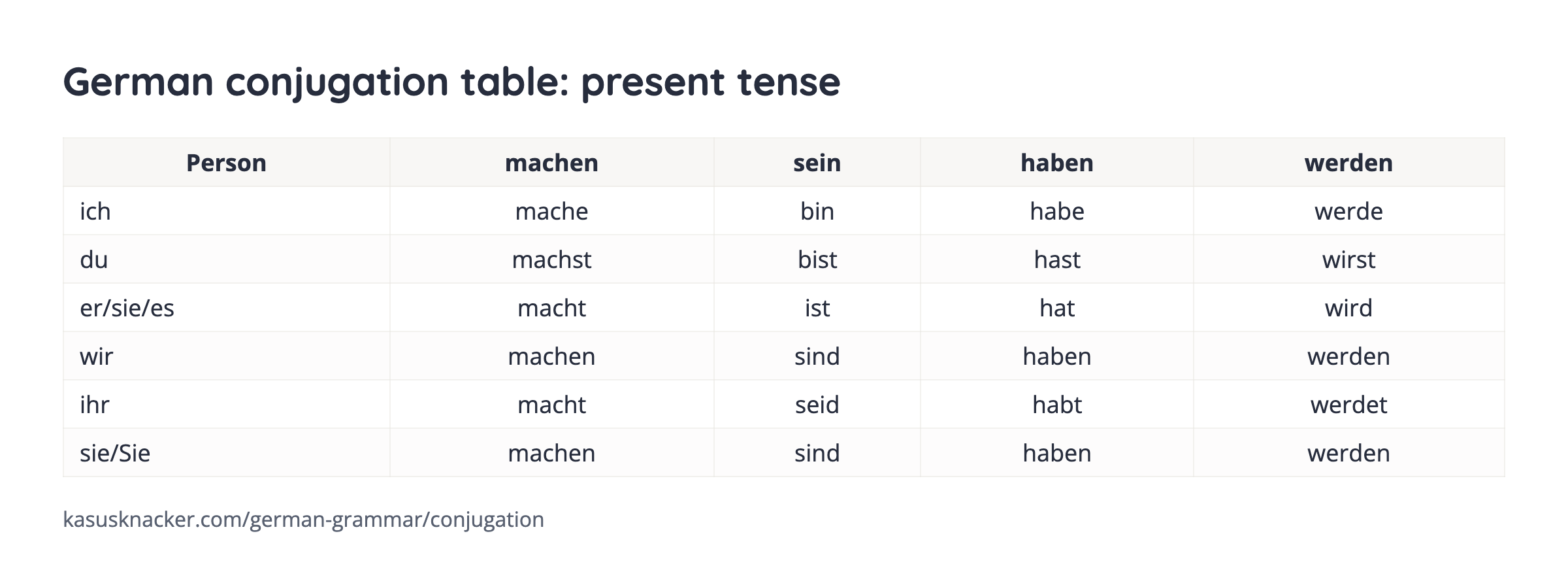
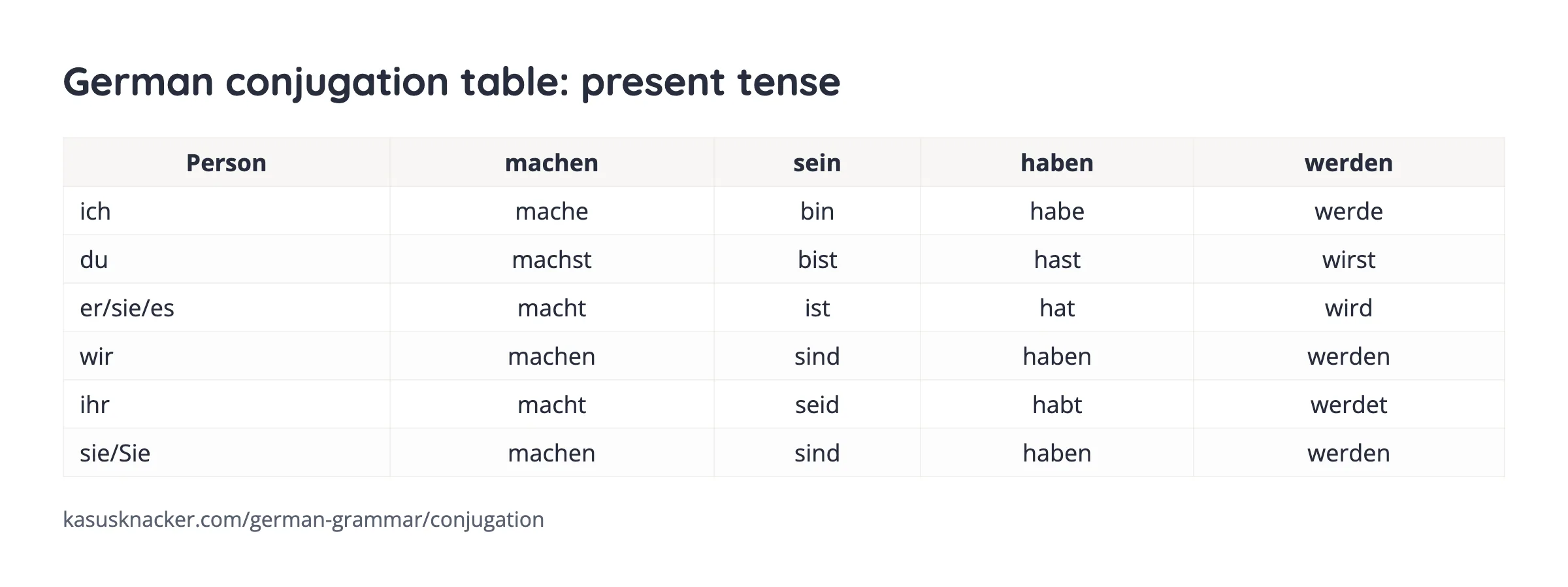
German conjugation table: present tense
This table covers the present tense for common verbs like machen, sein, haben and werden, which you will need in almost every sentence.
| Person | machen | sein | haben | werden |
|---|---|---|---|---|
| ich | mache | bin | habe | werde |
| du | machst | bist | hast | wirst |
| er/sie/es | macht | ist | hat | wird |
| wir | machen | sind | haben | werden |
| ihr | macht | seid | habt | werdet |
| sie/Sie | machen | sind | haben | werden |
German Verb Conjugation Rules Explained (Quick Start)
If you want a fast rules explanation, start with this checklist:
- Use the verb stem + person ending in the present tense (
-e, -st, -t, -en, -t, -en). - Watch stem changes in
duander/sie/esforms (for verbs likesprechen,fahren). - With modal verbs, conjugate the modal and put the main verb infinitive at the end.
- With separable verbs, move the prefix to the sentence end in main clauses.
- In Perfekt, build with
haben/sein+ past participle.
Present Tense (Präsens)
The present tense is the most commonly used tense in German. It's used for current actions, general truths, and even future events.
Regular Verbs
Most German verbs follow this pattern. Remove the -en ending and add:
| Pronoun | Ending | machen (to do) | spielen (to play) |
|---|---|---|---|
| ich | -e | mache | spiele |
| du | -st | machst | spielst |
| er/sie/es | -t | macht | spielt |
| wir | -en | machen | spielen |
| ihr | -t | macht | spielt |
| sie/Sie | -en | machen | spielen |
You can look up every tense of machen and spielen in the conjugator.
Stem-Changing Verbs
Some verbs change their stem vowel in the du and er/sie/es forms:
| Type | ich | du | er/sie/es |
|---|---|---|---|
| e → i: sprechen | spreche | sprichst | spricht |
| e → ie: sehen | sehe | siehst | sieht |
| a → ä: fahren | fahre | fährst | fährt |
| au → äu: laufen | laufe | läufst | läuft |
The conjugator has all forms of sprechen, sehen, fahren, and laufen.
Er spricht Deutsch.
He speaks German.
Important Irregular Verbs
Full conjugation tables (all tenses): sein · haben · werden
sein (to be)
| Person | sein |
|---|---|
| ich | bin |
| du | bist |
| er/sie/es | ist |
| wir | sind |
| ihr | seid |
| sie/Sie | sind |
haben (to have)
| Person | haben |
|---|---|
| ich | habe |
| du | hast |
| er/sie/es | hat |
| wir | haben |
| ihr | habt |
| sie/Sie | haben |
werden (to become)
| Person | werden |
|---|---|
| ich | werde |
| du | wirst |
| er/sie/es | wird |
| wir | werden |
| ihr | werdet |
| sie/Sie | werden |
Modal Verbs
Modal verbs express ability, permission, obligation, or desire. They have irregular conjugation. All tenses in the conjugator: können · müssen · wollen
können (can, to be able to)
| Person | können |
|---|---|
| ich | kann |
| du | kannst |
| er/sie/es | kann |
| wir | können |
| ihr | könnt |
| sie/Sie | können |
müssen (must, to have to)
| Person | müssen |
|---|---|
| ich | muss |
| du | musst |
| er/sie/es | muss |
| wir | müssen |
| ihr | müsst |
| sie/Sie | müssen |
wollen (to want to)
| Person | wollen |
|---|---|
| ich | will |
| du | willst |
| er/sie/es | will |
| wir | wollen |
| ihr | wollt |
| sie/Sie | wollen |
Modal Verbs in Real Sentences (Infinitive at the End)
The most important thing about modal verbs is not the chart. It’s the sentence structure:
- Conjugate the modal (kann/muss/will/…) in position 2
- Put the main verb in the infinitive at the end
Ich kann heute nicht kommen.
I can’t come today.
Wir müssen morgen arbeiten.
We have to work tomorrow.
Er will das Buch lesen.
He wants to read the book.
Common mistake
Subordinate clauses with modals
In subordinate clauses (weil/dass/…), the conjugated verb goes to the end:
Ich bleibe zu Hause, weil ich morgen arbeiten muss.
I’m staying home because I have to work tomorrow.
Modal takeaway
Separable Prefix Verbs (Trennbare Verben)
Many high-frequency German verbs have a separable prefix: aufstehen, ankommen, mitkommen, einkaufen, zumachen.
Rule in main clauses: prefix goes to the end
Ich stehe um 7 Uhr auf.
I get up at 7 o’clock.
Kommst du heute mit?
Are you coming along today?
How to spot them
Subordinate clauses: prefix attaches again
Ich gehe früh schlafen, weil ich morgen um 7 Uhr aufstehe.
I go to bed early because I get up at 7 tomorrow.
Separable verbs in the perfect tense
In Perfekt, the prefix stays attached and ge- goes between prefix and stem:
Ich bin um 7 Uhr aufgestanden.
I got up at 7 o’clock.
Wir haben im Supermarkt eingekauft.
We did grocery shopping at the supermarket.
Common mistake
Perfect Tense (Perfekt)
The perfect tense is the most common past tense in spoken German. It's formed with haben/sein + past participle.
With "haben" (most verbs)
Ich habe das Buch gelesen.
I have read the book. / I read the book.
With "sein" (movement/change of state)
Er ist nach Berlin gefahren.
He went to Berlin.
| haben verbs | sein verbs |
|---|---|
| machen → hat gemacht | gehen → ist gegangen |
| kaufen → hat gekauft | kommen → ist gekommen |
| essen → hat gegessen | fahren → ist gefahren |
| lesen → hat gelesen | fliegen → ist geflogen |
Find Perfekt, Präteritum, and more in the conjugator: kaufen, essen, lesen, gehen, kommen, and fliegen.
When to use sein
Past Participle Formation
| Type | Pattern | Example |
|---|---|---|
| Regular | ge- + stem + -t | machen → gemacht |
| Strong (irregular) | ge- + stem + -en | fahren → gefahren |
| -ieren verbs | stem + -t (no ge-) | studieren → studiert |
| Separable prefix | prefix + ge- + stem | aufmachen → aufgemacht |
| Inseparable prefix | prefix + stem + -t/en | besuchen → besucht |
Perfect tense with modals (double infinitive)
When a modal verb is in the past, German often uses a “double infinitive” at the end:
Ich habe heute nicht kommen können.
I wasn’t able to come today.
Wir haben gestern lange arbeiten müssen.
We had to work for a long time yesterday.
Don’t overthink it
Simple Past (Präteritum)
The simple past is mainly used in written German (news, stories). In speech, use Perfekt instead.
sein (Präteritum)
| Person | sein |
|---|---|
| ich | war |
| du | warst |
| er/sie/es | war |
| wir | waren |
| ihr | wart |
| sie/Sie | waren |
haben (Präteritum)
| Person | haben |
|---|---|
| ich | hatte |
| du | hattest |
| er/sie/es | hatte |
| wir | hatten |
| ihr | hattet |
| sie/Sie | hatten |
Imperative (Commands)
The imperative is used for commands, requests, and instructions.
| Form | machen | lesen | sein |
|---|---|---|---|
| du (informal) | Mach! | Lies! | Sei! |
| ihr (informal plural) | Macht! | Lest! | Seid! |
| Sie (formal) | Machen Sie! | Lesen Sie! | Seien Sie! |
Komm her!
Come here!
Lesen Sie bitte den Text.
Please read the text.
Conjugation Tips
Learn Patterns, Not Lists
Start with High-Frequency Verbs
Practice with Sentences
Common Mistakes (and Fixes)
Mistake 1: Forgetting the infinitive after a modal
Mistake 2: Putting the separable prefix in the wrong place
Subordinate clause: ..., weil ich aufstehe.
Mistake 3: Using Perfekt when Germans prefer Präteritum for sein/haben
German Verb Conjugator (By Verb)
Need one specific verb form fast? Use the verb-by-verb conjugator:
FAQ
How do I conjugate German verbs in the present tense?
Take the verb stem and add endings: -e, -st, -t, -en, -t, -en (ich/du/er-wir/ihr/sie). Some verbs change the stem vowel in du/er forms.
What are separable-prefix verbs?
Verbs like aufstehen or ankommen. In main clauses, the prefix moves to the end: Ich stehe um 7 Uhr auf.
What is the best way to learn irregular verbs?
Focus on the most frequent ones first and practice them in sentences. Repetition matters more than reading a list once.
Do I need all tenses to start speaking?
No. Start with present tense and perfect tense patterns. You can communicate a lot before mastering every tense.
Last updated:
Preparing for a German exam? See the core exam grammar checklist for A1–C1 →
Wrote a sentence with this rule? Check it with Schreibcheck →
Start cracking German grammar today.
Join thousands of learners mastering the German language with KasusKnacker.