German Adjective Endings (Declension): A Practical Guide
German adjective endings (Adjektivendungen) change based on case, gender/number, and the article/determiner in front of the noun.
If you follow a simple checklist, they become predictable.
3-question checklist
2) Which gender/number? (der / die / das / plural)
3) Which article type? (der-words, ein-words, or no article)
If “case” is the confusing part, review this first: German cases.
Which pattern am I in? The 30-second decision path
Before any table, answer one question: what stands directly before the adjective?
The decision path
2) An ein-word (ein, kein, mein, dein, sein…)? → mixed endings: ein guter Mann, meine gute Freundin.
3) Nothing (or a bare quantity like viele/einige)? → strong endings: guter Kaffee, viele nette Leute.
That is the whole system. Weak = the article does the grammar work. Strong = the adjective does it. Mixed = they share the job. Every table below is just this idea spelled out.
What counts as a "der-word" or "ein-word"?
You don’t need a long grammar definition. You just need to recognize the type of determiner in front of the adjective.
Der-words (weak declension after these)
These behave like der/die/das and already show clear case/gender info:
- der/die/das, dieser, jeder, welcher, mancher, solcher
- most of the time: alle (plural)
Examples: der gute Mann, dieses kleine Kind, mit der neuen Idee
Ein-words (mixed declension mainly in singular)
These behave like ein and sometimes don’t show enough info, so the adjective “fills the gap”:
- ein, kein
- possessives: mein, dein, sein, ihr, unser, euer, Ihr
Examples: ein guter Plan, meine gute Freundin, mit einem neuen Auto
Important nuance (plural)
The 3 patterns you need
| Pattern | When it happens | Typical endings |
|---|---|---|
| Weak | After der-words (definite articles + similar determiners) | mostly -e / -en |
| Mixed | After ein-words (ein/kein + possessives like mein/dein…) | some strong endings, otherwise -en |
| Strong | No article/determiner | adjective carries the case/gender info |
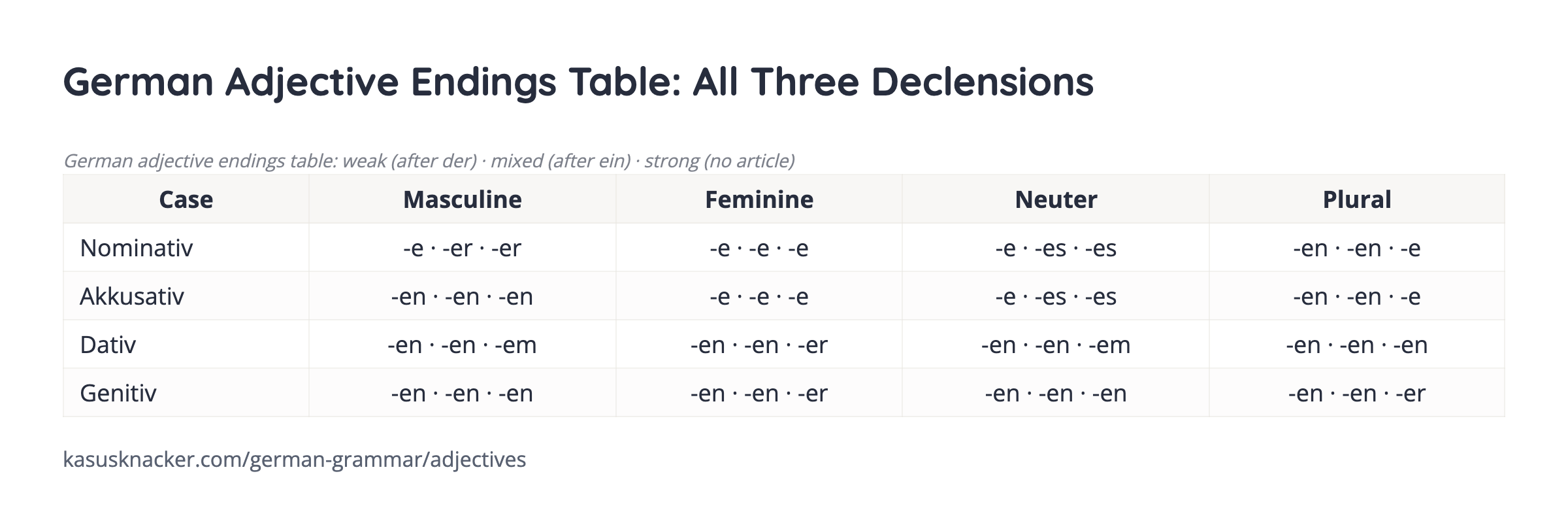
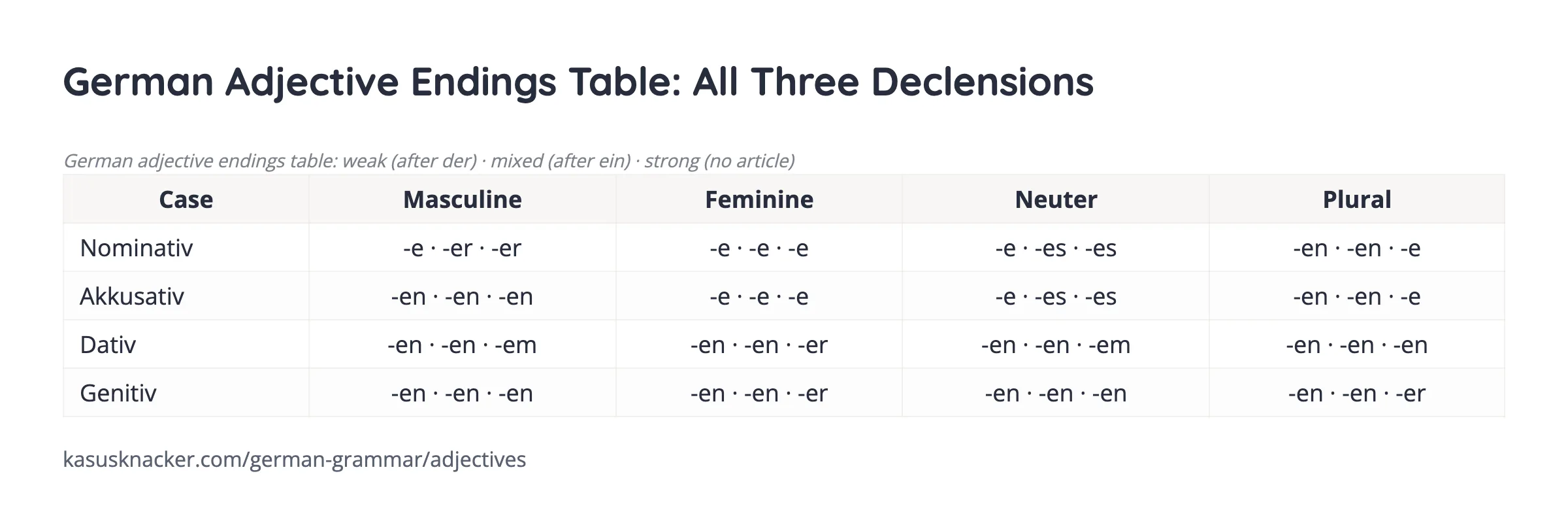
German Adjective Endings Table: All Three Declensions
The complete adjective declension in one table. Each cell shows three endings in this order: weak (after a der-word) · mixed (after an ein-word) · strong (no article):
| Case | Masculine | Feminine | Neuter | Plural |
|---|---|---|---|---|
| Nominativ | -e · -er · -er | -e · -e · -e | -e · -es · -es | -en · -en · -e |
| Akkusativ | -en · -en · -en | -e · -e · -e | -e · -es · -es | -en · -en · -e |
| Dativ | -en · -en · -em | -en · -en · -er | -en · -en · -em | -en · -en · -en |
| Genitiv | -en · -en · -en | -en · -en · -er | -en · -en · -en | -en · -en · -er |
Each of the three patterns is broken out below, with examples and memory aids.
Weak declension (after der/die/das)
After der-words, the article already shows case + gender clearly, so adjective endings are mostly -e or -en.
| Case | Masculine | Feminine | Neuter | Plural |
|---|---|---|---|---|
| Nominativ | -e | -e | -e | -en |
| Akkusativ | -en | -e | -e | -en |
| Dativ | -en | -en | -en | -en |
| Genitiv | -en | -en | -en | -en |
Ich sehe den guten Mann.
I see the good man.
Mixed declension (after ein/kein/mein…)
With ein-words, the article sometimes misses information (e.g., ein doesn’t mark feminine/masculine as clearly in every case), so the adjective “fills the gap”.
| Case | Masculine | Feminine | Neuter | Plural |
|---|---|---|---|---|
| Nominativ | -er | -e | -es | -en |
| Akkusativ | -en | -e | -es | -en |
| Dativ | -en | -en | -en | -en |
| Genitiv | -en | -en | -en | -en |
Das ist ein guter Plan.
That is a good plan.
Strong declension (no article)
When there is no article, the adjective must show the case/gender endings more clearly.
| Case | Masculine | Feminine | Neuter | Plural |
|---|---|---|---|---|
| Nominativ | -er | -e | -es | -e |
| Akkusativ | -en | -e | -es | -e |
| Dativ | -em | -er | -em | -en |
| Genitiv | -en | -er | -en | -er |
Guter Kaffee hilft immer.
Good coffee always helps.
Mnemonic
Example: der Mann → guter Mann; dem Mann → mit gutem Mann.
Common mistake
Quick workflow (what to do in practice)
Fast method
2) Pick the case (Nominativ/Akkusativ/Dativ/Genitiv).
3) Match the ending from the table and say the full phrase out loud.
Adjective endings case by case
Most mistakes cluster in one specific case. Here is what each case does to the adjective — with the triggers that tell you which case you are in.
Nominativ: the subject
The nominative is the "dictionary" situation: the person or thing doing the action. Endings here are the ones you learn first.
Der junge Hund schläft.
The young dog is sleeping.
Eine kluge Frau antwortet.
A smart woman answers.
Frisches Brot riecht gut.
Fresh bread smells good.
Akkusativ: the direct object
Triggers: the direct object of most verbs, and the prepositions durch, für, gegen, ohne, um. Good news: only masculine changes compared to nominative — feminine, neuter and plural stay identical.
Ich sehe den jungen Hund.
I see the young dog.
Wir kaufen einen neuen Tisch.
We are buying a new table.
Sie trinkt kalten Kaffee.
She drinks cold coffee.
Dativ: the indirect object
Triggers: the indirect object (to/for whom), dative verbs like helfen, danken, gehören, and the prepositions mit, nach, bei, seit, von, zu, aus. After any article, the adjective is always -en — dative is the easiest case for adjectives.
Ich helfe dem alten Mann.
I help the old man.
Sie kommt aus einer kleinen Stadt.
She comes from a small town.
Wir fahren mit guten Freunden.
We travel with good friends.
Genitiv: possession
Triggers: possession ("of the…") and the prepositions wegen, trotz, während, statt. The adjective is -en after articles; masculine/neuter nouns add -s/-es.
Das ist das Auto des neuen Nachbarn.
That is the new neighbor's car.
Trotz des schlechten Wetters gehen wir raus.
Despite the bad weather, we are going out.
Prepositions decide the case more often than anything else — if they trip you up, review German prepositions with cases.
Worked Examples (So It Feels Real)
Same noun phrase, three patterns
Notice how the adjective ending changes depending on what comes before it:
der gute Mann
the good man (weak)
ein guter Mann
a good man (mixed)
guter Mann
good man (strong)
Dative is where -en shows up everywhere
Ich helfe dem guten Freund.
I help the good friend. (weak, dative masculine)
Ich helfe einem guten Freund.
I help a good friend. (mixed, dative masculine)
Ich helfe gutem Freund.
I help good friend. (strong, dative masculine; rare but grammatical)
Adjective endings table: every pattern with example phrases
One compact cheat sheet — the five endings German actually uses are -e, -en, -er, -es, -em:
| Case + gender | Weak (der-words) | Mixed (ein-words) | Strong (no article) |
|---|---|---|---|
| Nominativ m. | der gute Mann | ein guter Mann | guter Kaffee |
| Nominativ f. | die gute Frau | eine gute Frau | gute Milch |
| Nominativ n. | das gute Kind | ein gutes Kind | gutes Bier |
| Akkusativ m. | den guten Mann | einen guten Mann | guten Kaffee |
| Dativ m./n. | dem guten Mann | einem guten Mann | gutem Kaffee |
| Dativ f. | der guten Frau | einer guten Frau | guter Milch |
| Genitiv m./n. | des guten Mannes | eines guten Mannes | guten Kaffees |
| Plural (Nom./Akk.) | die guten Männer | meine guten Freunde | gute Freunde |
| Plural (Dativ) | den guten Männern | meinen guten Freunden | guten Freunden |
When adjectives take NO ending: predicate adjectives
Here is the rule that removes half the stress: adjective endings only exist BEFORE a noun (attributive position). After verbs like sein, werden, bleiben, the adjective never changes (predicate position).
Der Mann ist gut.
The man is good.
Der gute Mann hilft uns.
The good man helps us.
Quick test
Special cases worth knowing
After viel, wenig, einige, mehrere
After einige, mehrere, viele, wenige (plural, no clear determiner), the adjective takes strong plural endings:
Ich kenne einige nette Leute.
I know some nice people.
Comparatives and superlatives decline too
Besser, größer, am besten are still adjectives — they take the same endings before a noun:
Wir suchen ein besseres Hotel.
We are looking for a better hotel.
Adjectives that never decline
A few adjectives stay unchanged before nouns, mostly colors and loanwords: rosa, lila, super, klasse, prima.
Sie trägt ein rosa Kleid.
She is wearing a pink dress.
Adjectives used as nouns
Nominalized adjectives keep adjective endings — they decline as if the noun were still there: der Deutsche but ein Deutscher, der Bekannte but mit einem Bekannten.
Participles work like adjectives
Present participles (infinitive + -d) and past participles decline exactly like normal adjectives when they stand before a noun:
Die lachende Frau winkt uns.
The laughing woman waves at us.
Wir kaufen ein gebrauchtes Auto.
We are buying a used car.
Ordinal numbers and city adjectives
Ordinals (erste, zweite, dritte…) decline like any adjective: der erste Tag, am dritten Tag. City adjectives in -er are the opposite — they NEVER change:
Ich liebe die Berliner Luft.
I love the Berlin air.
Several adjectives in a row
Two or more adjectives before the same noun all take the same ending (parallel declension):
Wir trinken guten alten Wein.
We drink good old wine.
Common Mistakes (and Fixes)
Mistake 1: Forgetting what changes in Akkusativ masculine
Mistake 2: Mixing strong and mixed in nominative singular
If you have no article, it’s strong: guter, gutes.
Mistake 3: Not treating plural separately
Key Takeaways
- Step 1 is always: identify the determiner type (der-words / ein-words / none).
- If you see -en everywhere, you’re probably in dative or plural.
- Mixed declension is mostly about the few “information gaps” in ein-words (especially nominative masculine/neuter).
- Practice in full phrases, not single words: it trains your ear and your speed.
Ready to practice? Open the app and drill adjective endings in real sentences.
FAQ
What are the German adjective endings?
German uses five adjective endings: -e, -en, -er, -es and -em. Which one you need depends on three things: the case, the gender and number of the noun, and whether a der-word, an ein-word, or no article stands in front of the adjective.
How do I know which declension to use?
Look at what stands directly before the adjective. A der-word (der, die, das, dieser, jeder) means weak endings. An ein-word (ein, kein, mein) means mixed endings. No article at all means strong endings — the adjective carries the case information itself.
Why is it ein guter Mann but der gute Mann?
Because ein does not show that the noun is masculine nominative, the adjective takes over and shows it with -er (guter). Der already carries that information, so the adjective relaxes to the weak ending -e (gute).
Do adjectives take endings after sein?
No. Adjectives after sein, werden and bleiben are predicate adjectives and never take an ending: Der Mann ist gut. Endings only appear when the adjective stands directly before a noun: der gute Mann.
Why are German adjective endings so hard?
Because the ending carries grammar information that may be missing from the article. The ending depends on the case, gender, and whether the article is definite, indefinite, or missing.
What are strong, weak, and mixed declension?
Strong endings appear when there is no article giving case/gender info. Weak endings appear after definite articles. Mixed declension happens after ein- words (ein, kein, mein) where the adjective sometimes carries the missing information.
What should I memorize first?
Start with the definite-article pattern (der/die/das), then learn the main strong endings, and finally the mixed pattern. Practice with short, repeated drills.
Do adjective endings change in plural?
Yes. Plural has its own patterns, and many learners improve quickly by practicing plural charts separately.
Last updated:
Preparing for a German exam? See the core exam grammar checklist for A1–C1 →
Wrote a sentence with this rule? Check it with Schreibcheck →
Start cracking German grammar today.
Join thousands of learners mastering the German language with KasusKnacker.